Fix-and-flip properties can offer attractive opportunities for real estate investors in Ohio. Older housing stock, properties needing modernization, and homes requiring significant repairs can sometimes be purchased below the value of comparable renovated properties.
But the purchase price is only the beginning.
Successful investors understand that profitability depends on accurately estimating the entire cost of the project before buying the property.
Here are the major expenses every investor should consider.
1. Purchase Price
The first number is obvious—but it shouldn’t be evaluated by itself.
A $100,000 property isn’t necessarily a better investment than a $150,000 property. What matters is how the acquisition price compares with renovation costs, carrying expenses, financing, and the property’s realistic value after improvements.
The goal isn’t simply to buy cheaply.
The goal is to buy at a price that leaves enough room for the investment strategy to work.
2. Renovation Costs
Renovations are often where projected profits begin to disappear.
Ohio’s older homes can require considerably more than cosmetic improvements.
Depending on the property, expenses may include roofing, HVAC, plumbing, electrical systems, windows, foundation repairs, kitchens, bathrooms, flooring, paint, landscaping, and structural work.
Investors should obtain realistic renovation estimates and include a contingency for unexpected problems.
3. Financing Costs
Borrowed money has a cost.
Depending on how the project is financed, investors may encounter interest, lender fees, points, appraisal expenses, inspections, draw fees, and other financing-related costs.
For foreign-national investors, financing structures and requirements may also differ from traditional residential lending.
These expenses should be incorporated into the investment analysis from the beginning.
4. Holding Costs
Every additional month a renovation takes can cost money.
Holding expenses may include:
- Property taxes
- Insurance
- Utilities
- Loan interest
- Lawn or snow maintenance
- Security
- Property management or oversight
A project that takes eight months instead of four can produce a very different financial result.
5. Buying and Selling Expenses
Investors also need to account for transaction costs on both sides of the investment.
Closing expenses, title-related costs, professional services, commissions when applicable, and other transaction expenses can significantly affect the project’s final return.
These costs shouldn’t be treated as an afterthought.
6. Know the After-Repair Value
After-repair value—or ARV—is an estimate of what the property may reasonably be worth after renovations are completed.
This number is critical.
An unrealistic ARV can make a poor investment look profitable on paper.
Comparable renovated properties in the immediate market should help support the projected value rather than relying on assumptions about what the property should be worth.
7. Build a Margin for the Unexpected
Renovation projects rarely go exactly according to plan.
A wall gets opened and reveals additional problems.
Materials cost more than anticipated.
A contractor discovers an issue that wasn’t visible during the initial walkthrough.
The project takes longer than expected.
Experienced investors account for uncertainty rather than assuming everything will go perfectly.
Run the Complete Numbers Before You Buy
A simplified investment analysis might look something like this:
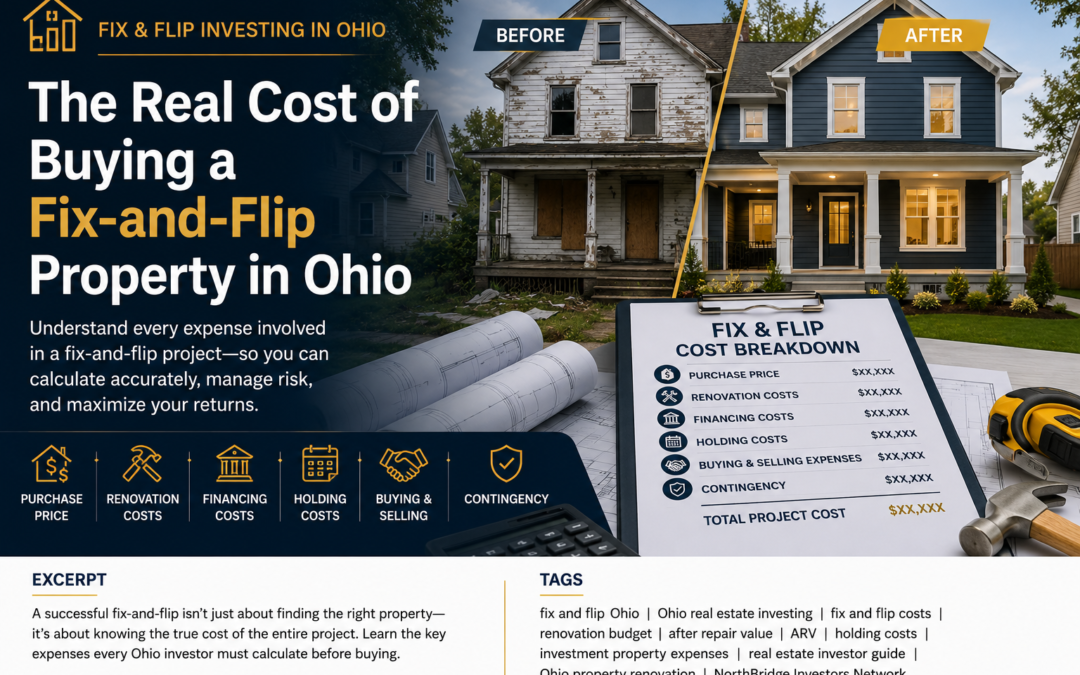
Purchase Price + Renovations + Financing + Holding Costs + Transaction Costs + Contingency = Total Project Investment
That total should then be compared against a realistic potential sale price and expected return.
If the numbers only work under perfect circumstances, the margin may simply be too thin.
The Contractor and Local Network Matter
For investors living outside Ohio, managing a renovation remotely adds another challenge.
Finding dependable contractors, obtaining realistic estimates, monitoring progress, handling unexpected problems, and keeping a project on schedule can be difficult from hundreds—or thousands—of miles away.
International investors face an even greater distance.
That’s why having reliable local resources can be an important part of the investment strategy.
Protect the Investment Before Chasing the Return
Fix-and-flip investing isn’t simply about finding inexpensive houses.
It’s about identifying properties where the acquisition price, renovation requirements, financing, timeline, market value, and potential return work together.
Sometimes the best investment decision is moving forward.
Other times, it’s walking away.
NorthBridge Investors Network helps investors evaluate Ohio opportunities and connect with the local knowledge and professional resources needed to make better-informed investment decisions.
Planning an Ohio Fix-and-Flip Investment?
Whether you’re located in Ohio, another state, or another country, understanding the complete project before purchasing can significantly reduce costly surprises.
Schedule a consultation with NorthBridge Investors Network to discuss your investment goals and explore how our Ohio network can help you move forward with greater confidence.